Here parents, educators, and therapists come together to share ideas to help children of all abilities function at their utmost potential. Useful information and tips regarding the challenges that children can face, as well as fun, educational crafts and games for children to do are covered here. Some of the topics addressed are sensory, fine motor, school readiness, autism, strengthening and crafts.
Showing posts with label movement. Show all posts
Wednesday, January 7, 2015
milk jug igloo
Kids love to play in forts. tents and other confined places. So, for winter we decided to try an "igloo" fort. Collect any size jug to make your igloo. We found it is easier to tape 3-4 together first, then tape these rows together. Make it as high and wide as you like. Have a snow ball battle from the fort.
Monday, December 1, 2014
Fun obstacle course to challenge ballance
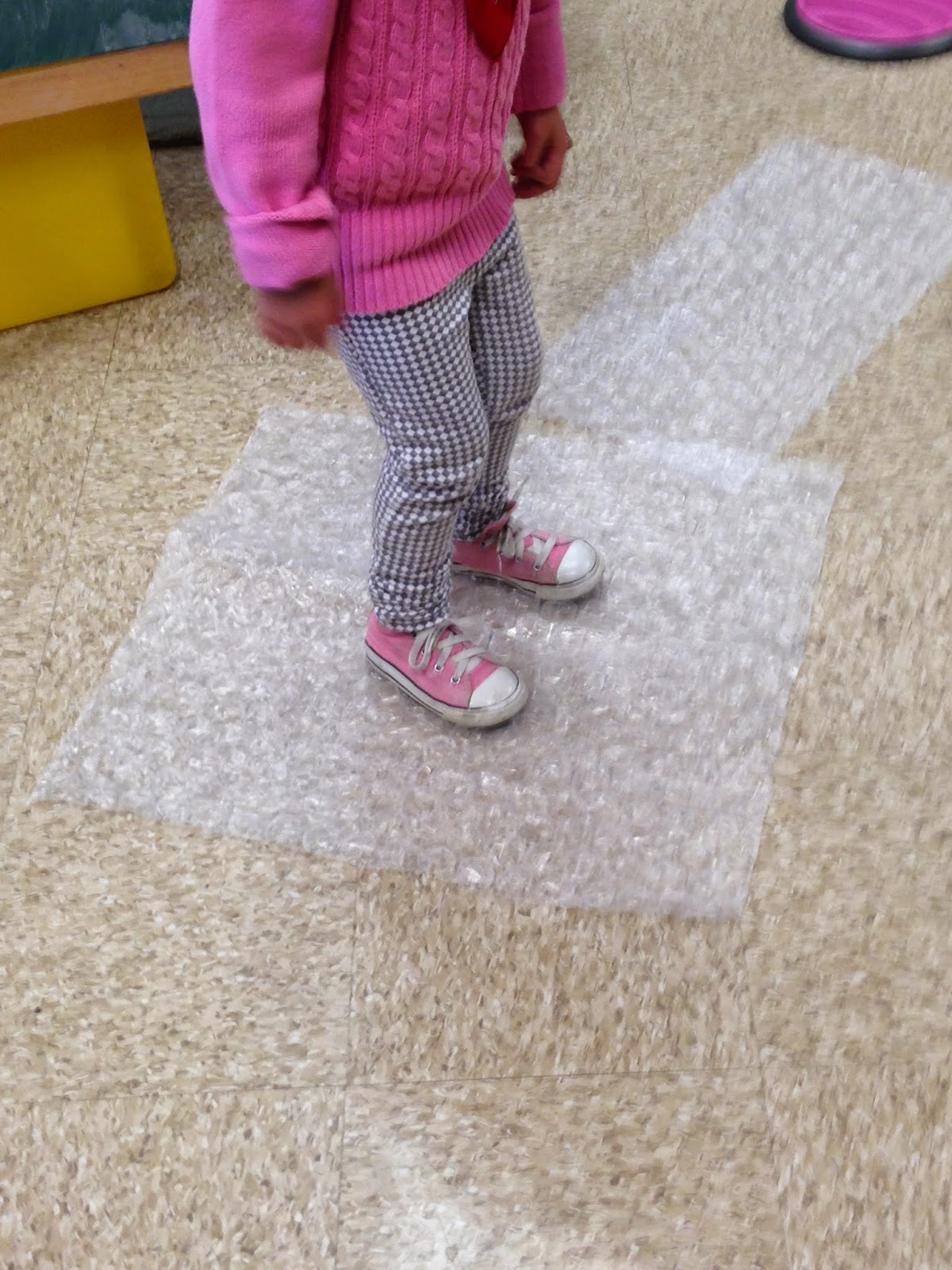
A fun way to transition between activities is by doing an obstacle course. When going from table top work to circle time, or vice versa, have the kids go via obstacle course. It not only entertains them, it can build their gross motor skills while allowing them the movement time they need during their school day to be able to learn most effectively. Studies show that children need time between sedentary learning times for gross motor to allow them to concentrate and to learn better. Try these ideas, or make your own obstacle courses. Ideas can be: crawling through a tunnel, hopping over an object, stepping up and down a stool, scooter boards and catching and throwing balls.
Have the kids jump on the bubble wrap to make cool popping noises.
Monday, July 21, 2014
Water Fun
It's hot outside- so get out the sprinkler and water table and have some fun! Give the kids squirt guns and have them squeeze the triggers (great hand/finger strengthening and eye-hand coordination). Put containers into a water table and have them pour water back and forth. Squirt them with water guns and watch them run (gross motor). Outside water fun is great fun for everyone.
Monday, October 14, 2013
Play ball!
It's still nice outside and perfect weather to spend time playing catch with your kids. It amazes me, and others, that kids these days do not know how to catch or throw a ball. In working with preschoolers, it is shocking just how many kids have no idea how to catch a ball thrown gently to them. Obviously, many of them have not ever been given the opportunity to learn this important skill. There are many benefits to learning to catch and throw balls. Eye-hand coordination is key to catching a ball. Muscle strength and coordination play a part, as well. If playing for a period of time, endurance is increasing. Playing with another child, or even adult, is building social skills and the skills necessary for team sports. So, please get out and play ball with your children. It is not only fun for the two of you, but great bonding time between a parent and child.
Monday, September 16, 2013
Learning colors
I recently had a teacher ask me for suggestions to help a child learn his colors. This child just wasn't grasping the idea of colors and, despite months of being taught his colors, could only name one. The teacher was frustrated and wondered if I had any suggestions. I assured her that she was not the first teacher to have this difficulty and told her that there are some children that have a particularly hard time with this concept. Colors are difficult for some children to learn because color is an abstract idea. We point to the car and say it is blue. The sky is blue, his eyes are blue, and so on and so on. A child is looking at the objects and thinking "how can they all be the same?" So, be sure to teach colors using alike items. Place 2 blocks in front of the child. Say, "these are both blocks- one is blue (point to it) and one is red (point to it)". Do this with a few items. I recommend using 2 completely different colors- not red/orange.
Once you have introduced the concept of colors, use the colors throughout your day. One suggestion I gave the teacher was to put construction papers on the back of the chairs. Give one child at a time a color to find and sit in that chair. At first have the child with difficulty choose between only 2 colors. Practice one color at a time (so have him find red for a few days until he is consistently picking it). Gradually increase the number of chairs/colors he picks from.
Another suggestion is to use gross motor to teach colors. We have mentioned in many posts how the use of movement increases a child's ability to learn. So, glue colored papers on a wall and have the children throw balls or beanbags at a color. Tape colored papers on the floor and have a child jump to a certain color.
Remember to label items with their colors throughout your day. Say, sit on the blue carpet; go to the red table; pick up the purple cup. Saturate your day with colors and you should see the children grasping the idea in no time!
Once you have introduced the concept of colors, use the colors throughout your day. One suggestion I gave the teacher was to put construction papers on the back of the chairs. Give one child at a time a color to find and sit in that chair. At first have the child with difficulty choose between only 2 colors. Practice one color at a time (so have him find red for a few days until he is consistently picking it). Gradually increase the number of chairs/colors he picks from.
Another suggestion is to use gross motor to teach colors. We have mentioned in many posts how the use of movement increases a child's ability to learn. So, glue colored papers on a wall and have the children throw balls or beanbags at a color. Tape colored papers on the floor and have a child jump to a certain color.
Remember to label items with their colors throughout your day. Say, sit on the blue carpet; go to the red table; pick up the purple cup. Saturate your day with colors and you should see the children grasping the idea in no time!
Sunday, August 25, 2013
Here's a way to make bowling at home different and fun. Take empty water bottles, peal the labels and put glow sticks in them! Wait until dark, then roll a small ball at them. You may want to keep the lids so you can put a small amount of water in the bottom to stabilize them a little more and to make it a little more difficult to topple over.
Thursday, August 22, 2013
Appropriate shoes for school
School has started, or is going to start in the next few days/weeks. So, I am going to pass along some words from my Physical Therapist colleagues- Please have your child wear appropriate footwear to school! Preschool and elementary children spend parts of every day on the playground or in a gym. So, please put safe and functional foot wear on your child. Appropriate foot wear includes sneakers (that fit- don't buy up a few sizes thinking to save money by wearing them longer- never works since kids ruin sneakers quickly) and tied, rubber-soled shoes. While little girls in flip flops or dressy shoes may look cute, it is not safe for them to wear these types of shoes to school. Dressy shoes are slippery and can cause your daughter to slip and fall, or to hang back and not run and play (This goes for boys and dressy shoes, as well). The dangers of flip flops, for both boys and girls, are self-explanatory. Although I think crocs are on the way out, there are still children wearing them to school Some schools have rules banning these ill-fitting, non-supportive shoes and the PTs I work with agree that they are not good, supportive shoes for children to wear to school. I feel that Crocs have there place- maybe to wear to swim practice or around the house, or on errands, but not at school. If it's raining and you want your child to wear rain boots to school (or snow boots in winter), be sure to send in sneakers for him/her to change into.
Part of your child's education is gross motor (in elementary and preschools) and you don't want to jeopardize this essential element of his education by allowing him/her to wear inappropriate footwear. Gross motor allows that movement break that young children need to fully function in the classroom. Research has shown an increase in attention and brain function if gross motor breaks are worked into the school day. So, allow your child to participate in the offered gross motor times so that he/she will function to the best of his/her ability in the classroom.
Sunday, June 30, 2013
Swing Kick Ball
Here's a game that my daughters made up- swing kick ball. It's simple, yet fun to play and can be played with only 2 people or with teams. Same concept as regular kick ball, except the kicker sits on a swing to kick. The person/people in the field try to catch the ball to get 3 outs. Lots of fun for the kids, plus it is great for visual motor skills, eye hand coordination, balance and endurance. Give it a try!
Monday, June 17, 2013
Summer Sensory Play
Summer is a great time to incorporate sensory play into your child's day. It's warm, sunny and the days last longer- so get out and enjoy your days. Here are some ideas for fun that also provide great sensory input:
1- Go to the playground
The playground is an excellent place to enjoy the outside and provides lots of opportunities for sensory input. Climbing, jumping, swinging and running are all great for sensory play. A playground is an ideal place for a child with motor planning difficulties to gain awareness of himself and he/she may be able to model other children's movements to learn to navigate the equipment.
2- Go Swimming
Water is not only fun and refreshing, but provides lots of sensory input. Try to swim as often as you can this summer, it's not just great exercise and good to increase endurance and strength, but provides sensory benefits and well as social benefits. Note that indoor pools may have too many auditory inputs that may be overwhelming to some children.
3- Play messy art outside
Take shaving cream outside and allow your child to finger paint. Put a big piece of paper on the clothesline and have your child fling paint at it using a paint brush. Draw with chalk and then use a squirt gun to erase it.
1- Go to the playground
The playground is an excellent place to enjoy the outside and provides lots of opportunities for sensory input. Climbing, jumping, swinging and running are all great for sensory play. A playground is an ideal place for a child with motor planning difficulties to gain awareness of himself and he/she may be able to model other children's movements to learn to navigate the equipment.
2- Go Swimming
Water is not only fun and refreshing, but provides lots of sensory input. Try to swim as often as you can this summer, it's not just great exercise and good to increase endurance and strength, but provides sensory benefits and well as social benefits. Note that indoor pools may have too many auditory inputs that may be overwhelming to some children.
3- Play messy art outside
Take shaving cream outside and allow your child to finger paint. Put a big piece of paper on the clothesline and have your child fling paint at it using a paint brush. Draw with chalk and then use a squirt gun to erase it.
Thursday, May 9, 2013
Yoga balls in the classroom
http://link.brightcove.com/services/player/bcpid1717807260?bctid=2363390457001
Try this link for an actual trial of balls instead of chairs in one 4th grade classroom. The physician/mom that recommended it is a parent in my son's cub scout pack and is one smart lady!
Thursday, March 28, 2013
Scooter Board Train
And yet another fun way to work out your kids' muscles on a scooter board... take two large cardboard boxes, paint them up and zip tie one scooter board to the middle bottom of one. Then cut out half the bottom of the front one and zip tie another scooter board to the rear (what's left) of the bottom of the box. Tie the two boxes together with some rope laced through the scooter boards and you have one fun train! We used some styrofoam packing scraps to make a headlight and tail end. Get as creative as you want... we tend to keep adding things as we play with it. Load up the back train car with another kid, stuffed animals, or cargo and have your child sit in the front one and use his feet to scoot around. If you cut windows in the engine, they can reach through and hold into the scooter board handles for assistance. Great for trunk stability and extremity strengthening!
Wednesday, March 27, 2013
Scooter Fun
Kids love scooter boards! And, they are great for upper body strengthening and coordination! Have your child lay on the board and pull the board with his/her hands, or have your child sit on the board and pull it using his/her feet. If you have access to a few scooters, have races. Or, if you only have one scooter, time how long it takes the child to get to a certain point, and have them try to beat other children's times. Or, just let your child ride the scooter.
Wednesday, March 20, 2013
Benefits of Skating for Sensory Seekers
OK, so I've been recommending this a lot lately... skating, whether it be ice or roller. There are many benefits to trying this activity. Great heavy work (got a high energy or sensory seeking kid?), balance, and self-esteem boost to name a few. Your child will sleep well that night! The trick is to find a place that will let you and your child approach the challenging task in your own way so as not to frustrate your child with too great a demand.
- Roller rinks will tighten the wheels so they roll less... try tightening them down so your child can walk on the wheels at first, then slowly loosen them. It might take a session or two to get to gliding, but this way they can advance at their own speed.
- Although they may seem harder, some kids respond better to rollerblades type wheels all in a row vs. the traditional roller skate two wheels in front two in the back. Try both kinds to see which one your child can move better.
- Ice rinks often use metal frames or even big orange cones for the kids to hang onto while they're learning to skate. It is harder than roller for sure, but if you're up for the challenge or a hockey or figure skating fan it's worth a try.
- If your child is pretty much skating, but still nervous, try holding a wooden spoon between the two of you... when you and he feel he's ready, you let go of the spoon. Sometimes they'll keep right on skating holding onto that spoon, watching them realize they're doing it alone is great!
| Challenging himself on the ice! |
| Resting on the boards... skating is hard work! |
Tuesday, January 29, 2013
Ways to transition
Watching some little friends line up today got me to thinking, "there's got to be an easier way!" There are many things you can do to help kids transition to lining up or between one activity and another. Using a sound (ringing bell, buzzer, that was easy button from Staples) will help kids recognize it's time to move. Lots of times a set of commands like "2 minutes, 1 minute, let's go" works well. When a child needs more help or cues than those try these:
- call kids by attribute (shirt, hair, eye color, etc.)
- have them crawl, hop, or spin to the target area
- sing a familiar song like The Ants Go Marching, or Clean Up, Clean Up
- use a long caterpillar or footsteps taped to the floor, or colorful cones for a visual cues
- use a picture schedule and have the child place the picture of the activity that's over into an envelope or pocket and do what the next picture on the schedule indicates
Remember when starting a new thing in the classroom, say taking your clothespin and pinning it to the center in which you're playing, lots of kids may get it right away. Some are going to need direct teaching a few or many times before it makes sense. Try a few ways of explaining, demonstrate with popsicle stick people or dolls, have the child draw himself doing it, we all learn differently!
What's your favorite way to transition?
Sunday, January 6, 2013
Scaries and Crashies
When thinking about kids and movement, it ranges from children that feel uncomfortable with even one foot off the ground to kids that can't get enough rides on the scrambler or like to bump into things or crash into the wall on purpose. There is much you can do during the early years of child development to enhance sensory integration skills. Here are some ideas to help with both types of children:
Movement Sensitivity
- To reduce gravitational insecurity (being nervous or scared when off balance) try swinging gently on a flat glider swing, jumping on a bounce pad, play row your boat with child sitting on a ball
- Rolling first on level ground, then down increasing grades of decline
- Swinging in a blanket
- Encourage swinging but don’t force (first low swing that feet touch the ground or hold him on your lap, hammock swing)
- Spinning (don’t spin without child’s permission, maybe over stimulating)
- Sliding different ways
- Riding vehicles
- Jumping on trampoline
- Walking on unstable surfaces
- Rhythmic rocking
- Seesaw
- T-stool
- Sitting on a ball or lying
- Tummy down, head up activities, try doing puzzles lying on your tummy on a pillow or ball
- Hoppity hop ball so the child can control the amount of sensory input coming
- A large tree swing or porch swing provides a gentler motion than playground swings
- Carrying heavy loads
- Slow, rocking movement (rocking chair, therapy ball or swing)
- Pushing and pulling
- Hanging by arms on playground equipment
- Pillow crashing
- Hermit crab - place a large bag of rice or beans of the child’s back and let her move around with the heavy “shell” on her back
- Joint squeezes
- Put one hand on the child’s forearm and the other hand on his upper arm. With slow, firm pressure, push his forearm and upper arm toward the elbow; then, pull them away.
- Push and pull the muscles near his knees and shoulders.
- Some kids feel centered with slight pressure on their shoulders or heads, press evenly, but not so much that the child feels trapped.
- Slowly straighten and bend his fingers, wrists, elbows, knees, ankles and toes.
- These extension and flexion techniques provide traction and compression to the joints and are effective when you're stuck in tight spaces, such as church pews, movie theaters, cars, trains, and especially airplanes where the gravity changes.
- Body squeezes
- Sit on the floor behind your child, straddling him with your legs
- Put your arms around his knees, draw them toward his chest, and squeeze hard
- Holding tight, rock him forward and back.
- Bear hugs, aim for at least 12 hugs a day, teach the child to hug himself before activities in which he's required to sit
- Pouring, the bigger the cups, jugs, and wading pool, the better for heavy work
- Opening doors
- Ripping paper or cardboard... my kids love to do this and break small branches for kindling for our fireplace
- Playing ‘bumpety-bump’ on the tire swing
- Line up standing back-to-back, play ‘hold up the wall’ by pushing into a wall with hands, back, lay down and push the wall with feet
- Tug-of-war
- Bulldozer- mat/cardboard – push load across the floor
- Playing catch
- Roughhousing
- Arm wrestling
- Leapfrog
- Warm bath - hold bubbles in hands and blow them, spray bottles, squeeze toys or ring out washcloth, wrap up like a mummy or bear hug dry off to calm
- Crunchy cereal, firm fruit (apples)
- Deep massage to body using lotion, try a lavender scent before bedtime
- Try sleeping or resting with a weighted blanket... don't go for more than 10% of your child's body weight for safety.
Subscribe to:
Posts (Atom)