First, let me say that there are, indeed some kids with aversions to different food textures and smells. There are kids with true sensory issues during meal times. These are not the kids I am referring to in this post.
The kids I am posting about today are kids that are shaped to have food preferences and behaviors. Kids that refuse to eat certain food groups, or textures. Kids that will eat only "kid friendly" foods such as chicken nuggets, french fries etc. Kids that are inadvertently shaped by their parents' behaviors and attitudes about food. I am not stating that these parents are bad parents or not doing what they feel is best for their child. For the most part, these parents just are not aware, or don't understand that they are negatively affecting their child's eating habits.
For example, I had a mom very concerned with the fact that her 5 year old child wouldn't eat anything but junk and "kid friendly" meals. She said her child would fuss and cry if presented with other food groups, especially fruits and she felt it was a sensory issue. This perplexed me since this child demonstrated no other sensory concerns. So, the next session I had with this child, I presented fruit for a snack. The child not only ate 3 servings, without any prompting from me, but cried when I ran out of the fruit. I then presented other "non-preferred" foods during my next few sessions, with the same results. As I was extremely baffled why this child's mother was concerned, I delved into the home life. And, as I had suspected, this child's "food aversion" was due to the parent's behavior. Turns out that mom doesn't eat fruits or vegetables, either, and therefore, they were not offered often at home. Mom asked what the kids wanted for dinner each night and then allowed them to "graze" on their food until they were finished. Of course, the kids requested "kid friendly" food and that is what the entire family ate every night. This mom had inadvertently caused her child's bad eating habits. It wasn't "sensory" at all, but a learned behavior. If the child fussed when presented with fruits or vegetables, they were immediately taken away to prevent a melt down.
Kids need to have a variety of foods to grow and for brain development. They needs fruits and vegetables to be healthy. These food should be offered often and kids should be encouraged to eat these foods at meals. Parents need to be good role models to their kids and demonstrate how good these foods taste. Meals should be presented at a table or island and kids need to sit to eat and not wander around, taking bites now and then until they are done eating. Good eating habits start in the home, and should start early on in life. The older a child gets, the more difficult it is to change bad eating habits. Present non-preferred foods many times and have the child take one bite before eating a preferred food. I find some parents are afraid of upsetting their child so don't push things that may not be liked by the child. Consistency is key to instilling good eating habits and it is ok to upset your child so that he/she will grow up healthy.
Friday, December 11, 2015

Monday, June 15, 2015
It's Summer!!!!
It's summer and time to decompress! Schedules get easier, the days get longer and it's time for some fun in the sun. Kids need down time, too, so allow them to relax some of the time and enjoy their summer. But, that doesn't mean plopping them in front of the tv, ipad or phone all day, every day. Go to the pool, amusement park or playground. Take them to visit friends and have some friends over to play. Get your kids outside for some fresh air and exercise. Remember, though, to have them read, or read to them. Have special time in your day to enrich their minds so they are ready to go back to school on track. It is a known fact that kids can loose knowledge over the summer if not properly stimulated. So, allow your kids to enjoy their time off, but have them do some school work too so they are not behind in the fall. Happy summer, and be safe!
Monday, April 27, 2015
HAPPY OCCUPATIONAL THERAPY MONTH!!!!!!
April is Occupational Therapy month so thank an OT for all they do. Happy OT month to all our fellow therapists!

Monday, April 13, 2015
Cute Chic


Monday, March 16, 2015
Good Read
I came upon this article about teaching young children. Good read and would love to start discussion about people's opinions. Please take the time to read and comment if you would like.
http://www.slate.com/articles/double_x/doublex/2011/03/why_preschool_shouldnt_be_like_school.html?wpsrc=sh_all_mob_fb_top
Going into preschools, I see them progressively becoming more and more like kindergarten in what is expected from the children, so this article is relevant in today's world.
http://www.slate.com/articles/double_x/doublex/2011/03/why_preschool_shouldnt_be_like_school.html?wpsrc=sh_all_mob_fb_top
Going into preschools, I see them progressively becoming more and more like kindergarten in what is expected from the children, so this article is relevant in today's world.
Monday, February 9, 2015
Bubble wrap bee hives


Friday, January 23, 2015
Home Made Fine Motor Activity

Wednesday, January 7, 2015
milk jug igloo


Monday, December 1, 2014
Fun obstacle course to challenge ballance
A fun way to transition between activities is by doing an obstacle course. When going from table top work to circle time, or vice versa, have the kids go via obstacle course. It not only entertains them, it can build their gross motor skills while allowing them the movement time they need during their school day to be able to learn most effectively. Studies show that children need time between sedentary learning times for gross motor to allow them to concentrate and to learn better. Try these ideas, or make your own obstacle courses. Ideas can be: crawling through a tunnel, hopping over an object, stepping up and down a stool, scooter boards and catching and throwing balls.
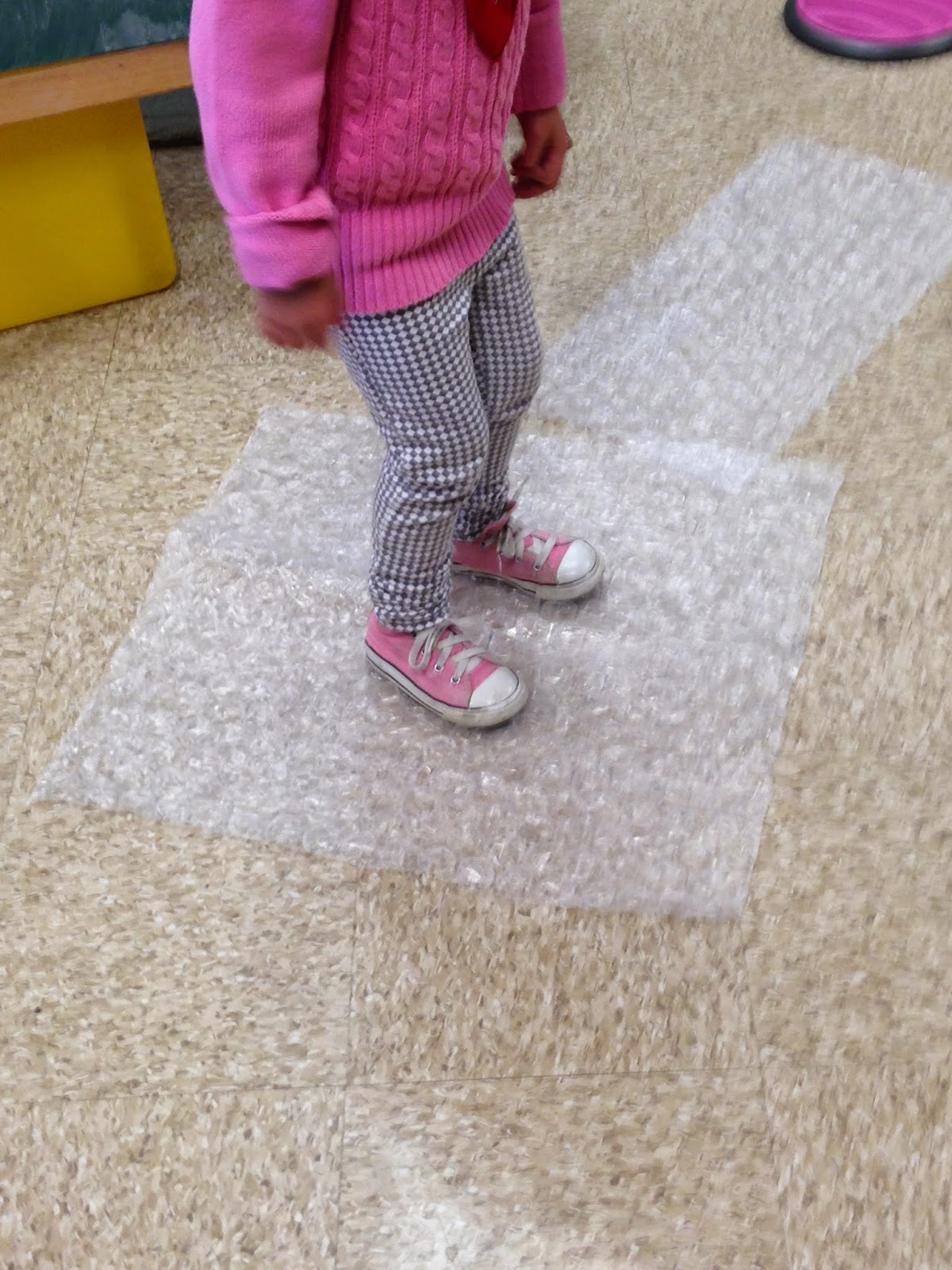
 Have the kids jump on the bubble wrap to make cool popping noises.
Friday, November 21, 2014
Puffy paint painting


Friday, November 14, 2014
Toilet training a child with sensory difficulties
Toilet training a child with Sensory Integration Dysfunction
can prove to be frustrating to both parent and child. A child with SID may not feel the urge to
“go” as typical children do. It may take
additional time to toilet train a child with SID and the child may show
readiness signs at an older age than their typically developing peers. It is important that parents realize that
toileting training a child with SID may be frustrating and challenging and
understand that it may also be frustrating and challenging for their child. Here are some toilet training strategies and
tips to assist in toilet training a child with SID:
-Be sure that your child is ready to start toilet
training. Remember, a child with SID may
not be ready at the same age as typically developing peers. Is your child noticing when his/her diaper is
dirty? Does she let you know, either
verbally or by her actions, that she needs to “go”? Is she bothered by dirty diapers?
1-
Plan a fun night to go choose underwear. Allow your child to pick her underwear. Make a big deal about how she is becoming a
big girl and can now wear underwear.
2-
Before actually putting your child on the
toilet, look around the room where the toilet is to determine if there are
things in the room that may hinder your child’s success. If your child gets overwhelmed by clutter,
de-clutter the room. If your child is
bothered by smells, try to mask any odors in the room. If bright lights are an issue, put in lower
watt bulbs, etc.. The idea is to make
the room as friendly as possible for your child.
3-
Create a “Potty Time Basket” for your child that
you will place beside the toilet. Include
things such as books, toilet paper, wipes, reward stickers (or whatever you
choose to be a reward).
4-
You can make toilet training “fun” for your
child by adding food coloring to the toilet and telling your child to see what
color the water changes to after she pees in it. For boys, add “targets” to aim at such as
Cheerios.
5-
If your child is Pee trained, but not trained
for Poop, have her participate in you dumping her poop from her diaper into the
toilet and flushing it down. Tell her
that poop goes in the toilet.
6-
Avoid punishing your child for “accidents”
during the toilet training process. Give
encouragement and praise when she does get to the toilet.
7-
Allow your child to help pick out a potty chair
or seat. Having a potty seat can make
the toilet less intimidating and scary and may decrease fears of falling into
the toilet. Potty chairs can be place
anywhere in the house to make toileting convenient for your child. If your only toilet is on a different floor
than your child typically is, perhaps a potty chair would be right for you.
Occupational Therapists can assist in the toilet training
process by offering advice and strategies, if needed. Parents of children with SDI can use many of
the same strategies for toilet training that they use with their typically
developing children, but it is important to remember that the process may need
to be altered to accommodate for the needs of the child with SDI and that the
process may take much longer than it would with another child. Make the process as stress-free as possible
and allow your child to toilet train at their own pace.
Subscribe to:
Posts (Atom)